
Inflatable Tent for Sports: Finish Lines, Race Villages & Sideline Shelters
A deployment guide for sports organisers: which platforms carry a start/finish arch, how a race village is zoned, what event-day operations look like from load-in to load-out, and how sponsor branding stays visible from the grandstand and the air. KCCE has 20 years of manufacturing experience.
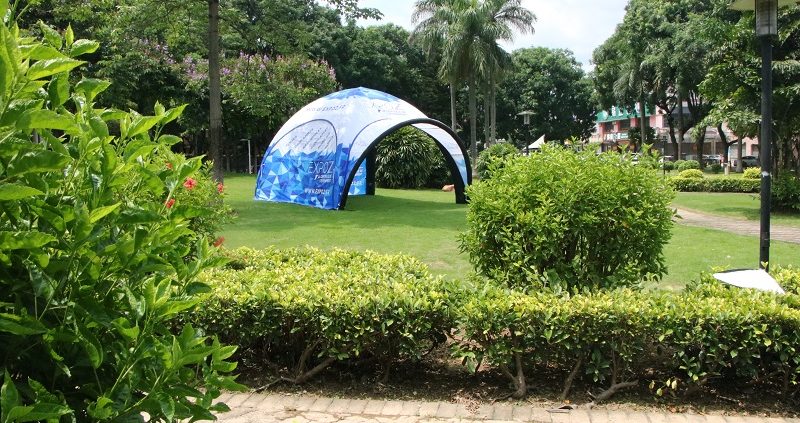
An inflatable tent for sports is an air-frame structure built for event-day duty: arch platforms span the start/finish line, dome platforms hold registration and team areas, and the same Oxford-cloth canopy and welded TPU air-frame carry custom print from a single club logo to a full sponsor wrap. A custom inflatable tent for sports from KCCE starts at MOQ 1 unit, draws on 13 documented tent platforms plus columns and arches in one catalogue, and is quoted per project in writing.
What You’ll Learn
- 01What an Inflatable Tent for Sports Does
- 02Sports & Deployment Formats
- 03Event Zones: Arch, Dome, Shelter, Village
- 04Event-Day Operations
- 05Race-Village Fleet Planning
- 06Sponsor Visibility & Branding
- 07Site, Wind & Weather
- 08Seasonal Programs & Storage
- 09Explore Tent Platforms
- 10Setup on Site
- 11Pricing & MOQ
- 12Custom Tents in Action
- 13Sports Scenes from the Field
- 14Foire aux questions
What an Inflatable Tent for Sports Does
Sports events need shelter that goes up fast, carries branding the cameras can see, and comes down just as cleanly when the course reopens. That is the job an inflatable tent for sports does. Instead of a rigid marquee that needs a build crew and a half-day, the air-frame structure inflates on site from a packed bag, anchors to the documented procedure for the ground it stands on, and deflates into the same bag at load-out.
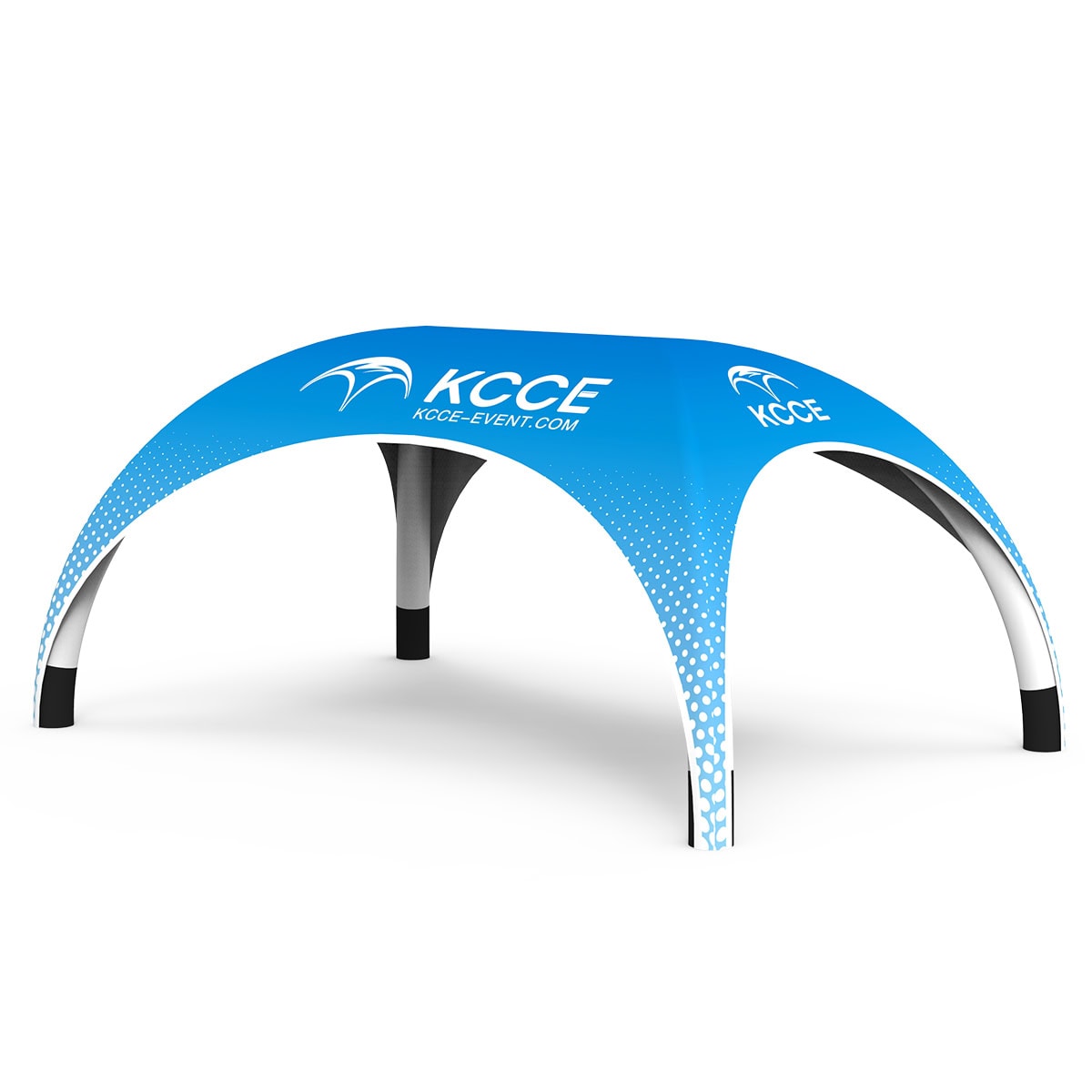
The hardware splits into two families. Arch platforms span open ground — the start/finish line, a sponsor gate, a photo point — and put printed faces in front of the grandstand and the broadcast camera. Dome platforms give enclosed floor space for registration desks, team areas and sponsor villages, with sidewalls and connecting cloths that extend them as entries grow. Both run on the same construction: an Oxford cloth canopy over welded TPU air-frame tubes, custom-printable, with the inflation and safety valves and spares listed in the accessories bag.
A custom inflatable tent for sports is bought as a deployment, not a one-off. Your artwork becomes a print proof, the proof is approved in writing, and every later unit — this season’s next race or next year’s repeat — prints against the same reference, so the fleet matches from the first arch to the last flag. KCCE has manufactured inflatable structures since 2006, and the catalogue spans 13 documented tent platforms, air-tight columns and arches.
The rest of this page walks the deployment in order: which formats suit which sports, how the zones of an event map onto platforms, what event-day operations look like, how a race-village fleet is planned, and how seasonal programs reuse the same units year after year.
Sports & Deployment Formats
Each sport stresses a different part of the event - the arch carries the timing point, the dome carries the crowd.
| Sport / format | What the structure does | Typical layout |
|---|---|---|
| Road cycling & mass-participation rides | Branded start/finish arch, registration dome, feed-zone shelter | One arch plus one or two domes |
| Motorsport & dealer events | Paddock shelter, sponsor arch, flag line across the forecourt | Dome plus arch, flags and awnings |
| Winter & ski programs | Resort arch, base-area dome, seasonal repeat through the winter | Printed arch plus dome, repeated per season |
| Air sports & skydiving | Landing-zone dome, gear-check shelter, wayfinding flags | Dome plus columns and flags |
| Field & team sports | Sideline shelter, team area cover, awards backdrop | Dome with sidewalls plus printed walls |
| Endurance & adventure races | Checkpoint shelters, finish village, multi-day fleet | Multi-unit fleet with connecting cloths |
The format sets the layout, not the hardware: every row above is built from the same documented platforms, so an event that grows from a club ride to a regional race extends the kit instead of re-specifying it.
Event Zones: Arch, Dome, Shelter, Village
A sports event is a set of zones, and each zone maps onto a platform: the arch takes the line, the dome takes the crowd.
Start / finish arch
- Arch platforms span the timing point so printed faces read from the grandstand and the broadcast camera.
- The same arch repeats at every race of the series, printed against the approved proof on file.
- Square, angled and round arch shapes cover narrow street finishes and wide open field starts.
Registration & check-in dome
- Dome platforms give enclosed floor space for desks, queues and gear tables.
- Sidewalls close off weather; doors manage the flow of entries through the morning.
- Connecting cloths join a second dome when entries outgrow the first.
Spectator & team shelter
- Larger dome platforms with sidewalls shelter spectators and give teams a pit base.
- Printed walls extend sponsor branding along the shelter line.
- Units anchor to the documented procedure for the ground they stand on.
Sponsor village
- Multiple domes plus air-tight columns and feather flags build the village footprint.
- Each sponsor zone prints from the same approved artwork, so the village reads as one program.
- The village repeats at the next event from the proof on file.
Event-Day Operations
From load-in to load-out, the day runs on a documented sequence - the same one every event, so the crew never improvises.
Load-in & layout
- Units arrive packed in transport bags; the layout plan from the quote positions arch, domes and flags against the course map.
- The crew marks each footprint before anything is unrolled.
Inflation sequence
- Each air-frame inflates on site with the documented inflation equipment, following the platform's setup order in the manual.
- Tube pressure and valve seating are checked as each structure rises.
Anchor & ballast check
- Anchoring and ballast follow the documented procedure for the platform and the ground conditions.
- The crew signs off the anchor check before doors open to entries.
Event window
- Structures stay inflated through the event; sidewalls and doors manage weather and crowd flow.
- Spare stakes, guy ropes and repair patches stay in the accessories bag on site.
Deflation & load-out
- Deflation and packing reverse the setup order, and units fold into their transport bags.
- The next event repeats the same layout against the proof on file.
Race-Village Fleet Planning
Plan the village by zone, then let the catalogue extend it.
| Event scale | Tent layout | Add from the same catalogue |
|---|---|---|
| Club / local race | One arch plus one registration dome | Feather flags, printed walls |
| Regional / one-day race | One arch, two domes, flag line | Air-tight columns, awnings |
| Multi-day stage race | Multiple domes with walls and connecting cloths | Spare covers, valves, repair patches |
| Championship / festival | Full village: domes, columns and arches | Branded documentation, private-label packing |
Fleet size is a zoning decision, not a package: start from the zones the event runs, then extend from the same catalogue. A whole season can be quoted at once so every event on the calendar matches.
Sponsor Visibility & Branding
Sponsor money buys visibility: the print is planned around where the cameras and the crowd actually look.
Print layers on the product
- Canopy panels, walls and banner areas carry heat-transfer print from vector artwork.
- A single-panel logo is the smallest change; a full-canopy wrap prints edge to edge.
Repeatable across a season
- Layout and colour lock at the written proof stage, not mid-production.
- The approved proof stays on file - every later unit prints against the same reference.
Beyond the tent
- Columns, arches and feather flags extend the same artwork across the venue.
- Printed walls and awnings carry sponsor messaging along shelter lines and feed zones.
Visibility where it counts
- Printed arch faces read from the grandstand and the broadcast camera.
- Full-wrap domes read from distance and from aerial coverage - the reason air-sports brands choose them.
Site, Wind & Weather
Nothing on this page claims a wind rating - the manuals do not publish one. Weather is managed by site choice, documented anchoring and crew procedure.
Site selection
- Level, clear ground away from overhead lines and standing water.
- The course map fixes each unit's footprint before load-in day.
Anchoring & ballast
- Anchor and ballast follow the documented procedure for the platform and ground.
- Stakes, guy ropes and ballast options are listed in the accessories bag for each model.
Weather windows
- Rain is handled by sidewalls and doors, not by a printed rating.
- Crews follow the venue's weather plan and monitor the forecast through the event window.
Between events
- Deflate, dry, fold and bag; inspect valves and seams before the next load-in.
- Spare covers, valves and TPU repair patches replenish with later shipments.
Seasonal Programs & Storage
A sports calendar repeats - the structures are bought once and deployed all season.
Winter programs
- Ski resorts and winter festivals run printed arches and domes through the season.
- The same units repeat year on year against the proof on file.
Off-season storage
- Deflated units bag compactly for storage between seasons.
- Spare covers, inflation and safety valves matched to each model, plus TPU repair patches, keep the fleet in service.
Transport between events
- Units pack into transport bags; mixed shipments of tents, columns and arches travel under one document set.
- The whole season can be quoted at once - units, spares and print.
Season planning
- Quote the series, not the single date: every event of the season matches.
- New zones extend from the same catalogue without changing suppliers or print methods.



Setup on Site
Setup is a sequence, not a stunt: layout, inflation, anchoring and sign-off run in the documented order on every event day.

Layout
The canopy is unrolled and positioned on the marked footprint before inflation begins.
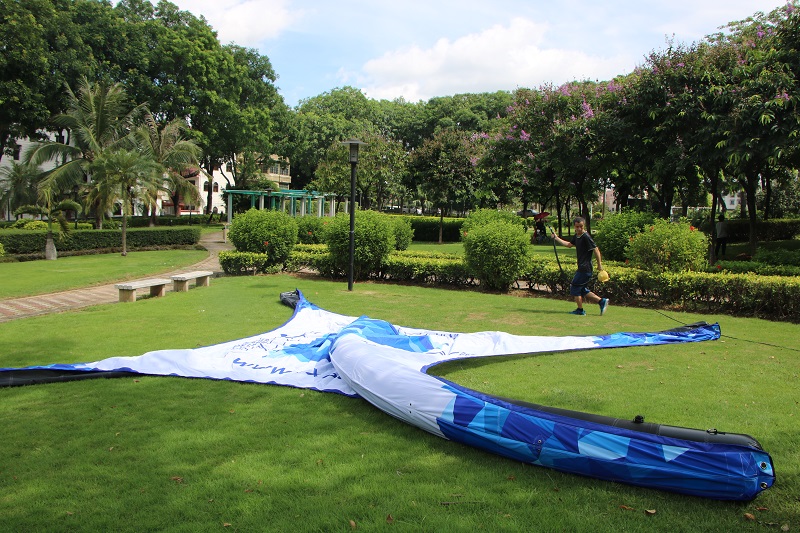
Inflation
The air-frame fills on site with the documented inflation equipment while the crew checks anchoring.
Unpack & position
- Units arrive packed in transport bags, one per platform.
- The layout plan from the quote positions every unit against the course map.
Inflate & anchor
- Inflation follows the platform’s documented setup order.
- Anchoring and ballast follow the documented procedure for the ground.
Sign-off
- The crew checks tube pressure, valve seating and anchor points.
- Doors open to entries only after the anchor check is signed off.
Load-out
- Deflation and packing reverse the setup order.
- Units fold into transport bags for the next event on the calendar.
Pricing & MOQ
Custom print starts from 1 unit; pricing is quoted per project on FOB terms and confirmed in writing after design approval.
| Order type | Quantité minimale de commande (QMC) | Lead time |
|---|---|---|
| Custom printed sports layout | 1 unit | Confirmed in writing after design approval |
| OEM / ODM program | Discuss | Confirmed in writing after design approval |
| Season fleet (multi-event) | Discuss | Confirmed in writing after design approval |
No price list is published because every layout is quoted against the course map, the print scope and the shipment terms - the written quote is the reference.
A: It covers the four zones a sports event actually needs: a start or finish arch across the timing point, a registration dome for check-in, shelter for spectators and teams, and a sponsor village of domes, columns and flags. The same catalogue covers club-level one-day races and multi-day stage races - the layout changes, the platforms do not.
A: Yes. Canopy panels, walls and banner areas carry heat-transfer print from vector artwork, and custom print runs from a single unit - so a first club arch already buys at factory source. Layout and colour lock at the written proof stage, and the approved proof stays on file as the reference for every later unit.
A: Arch platforms span the timing point and put printed faces in front of the grandstand and the broadcast camera. Dome platforms give enclosed floor space for desks, queues and gear, with sidewalls and connecting cloths to extend them. Most events pair one arch with one or two domes; the layout is confirmed in the written quote.
A: It depends on the zones you run, not on a fixed package: a club race typically pairs one arch with one dome, while a multi-day stage race adds domes, walls and connecting cloths for check-in, feed zones and the finish area. The village layout is planned against your course map and quoted per project.
A: Structures are anchored and ballasted to the documented procedure for each platform and ground condition, on sites chosen to be level and clear of overhead lines. Rain is handled by sidewalls and doors rather than by a printed rating, and crews follow the venue's weather plan. No wind figure is claimed here because none appears in the product manuals.
A: Setup follows the documented sequence for each platform - layout, inflation, anchoring, sign-off - and the schedule for the morning is set by crew size and site conditions, confirmed in the event plan rather than promised as a fixed time.
A: Yes. Each unit deflates, dries, folds and bags after the event, and the next load-in repeats the same layout against the proof on file. Spare covers, inflation and safety valves matched to each model, TPU repair patches and spare stakes and guy ropes ride along with later shipments, so a season of reuse does not become a sourcing exercise.
A: Custom print starts from 1 unit - there is no volume gate before custom work begins. Pricing is quoted per project on FOB terms and confirmed in writing after design approval, with the approved proof and the written quote as the reference for everything that follows.
A: They come from the same catalogue and can travel in one shipment under one document set: air-tight cube and cylinder columns in Regular and Zipper versions, square, angled and round arches, plus feather flags and printed walls to extend the sponsor branding across the venue.
A: Deflated units pack into their transport bags, and mixed shipments of tents, columns and arches are prepared for your forwarder under a single document set. For a series, the whole season can be quoted at once so every event on the calendar matches.
Custom Tents in Action
Each project below was built with a KCCE platform and customized for the client’s branding, event type, and footprint.
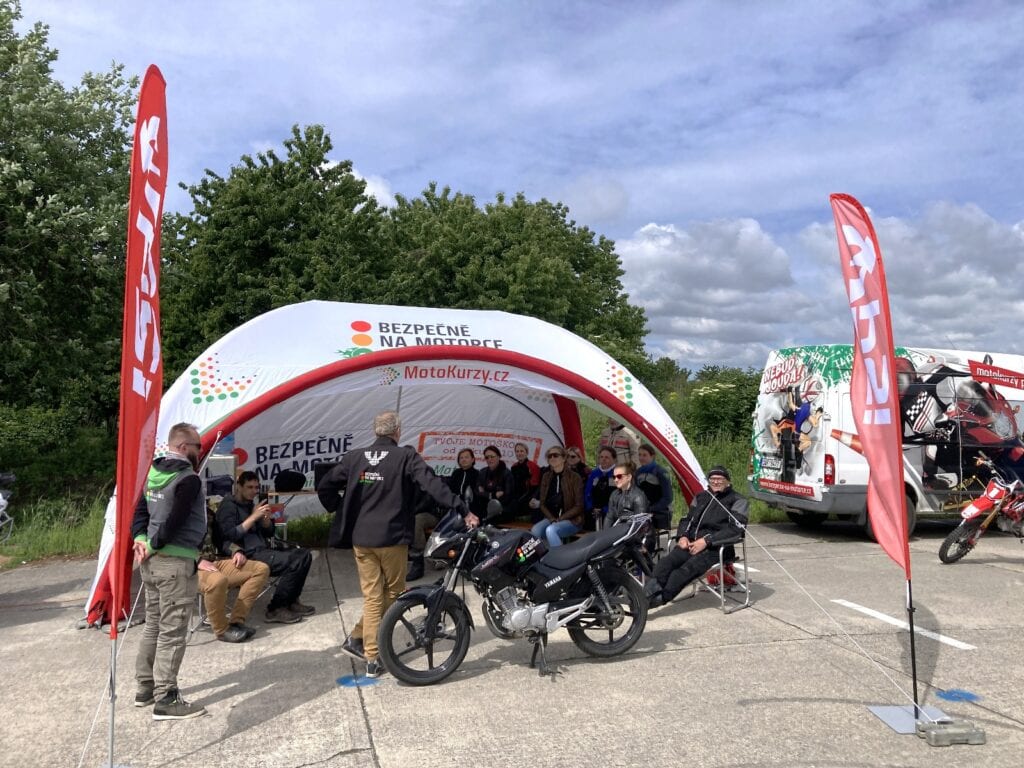
Motorcycle Safety Roadshow
Custom-printed red arch plus matching feather flags delivered as a complete kit for a multi-stop roadshow.
- X platform
- Custom print
- Flag bundle
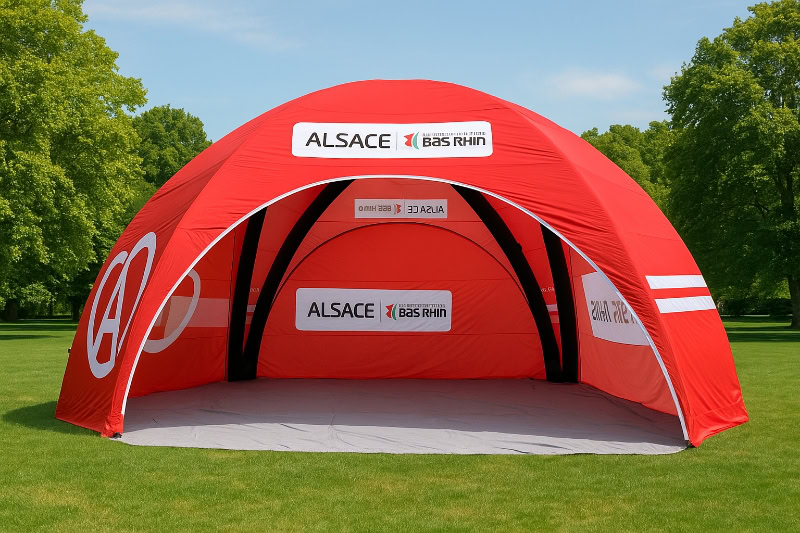
Public-Sector Brand Campaign
Branded red dome tent with repeated logo panels for an Alsace regional campaign. Print carried across canopy and sidewalls.
- AII platform
- Full canopy print
- Sidewalls
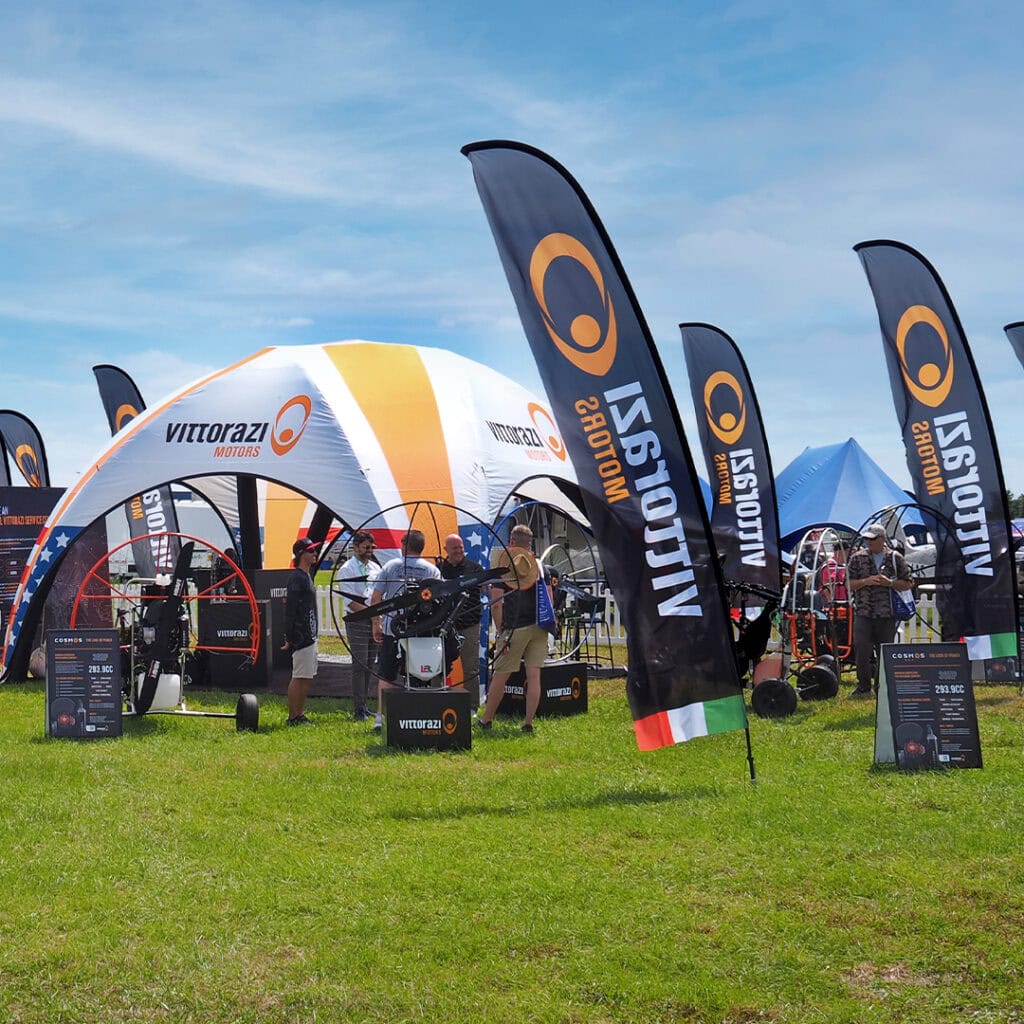
Paramotor Brand Activation
Italian paramotor brand activation with a multi-arch layout, custom-printed canopies, and matching advertising flags.
- N / X platform
- Multi-unit
- Flag set
Sports Scenes from the Field
Cycling, motorsport, winter and air-sports deployments - each built on a documented platform and printed to the client’s artwork.
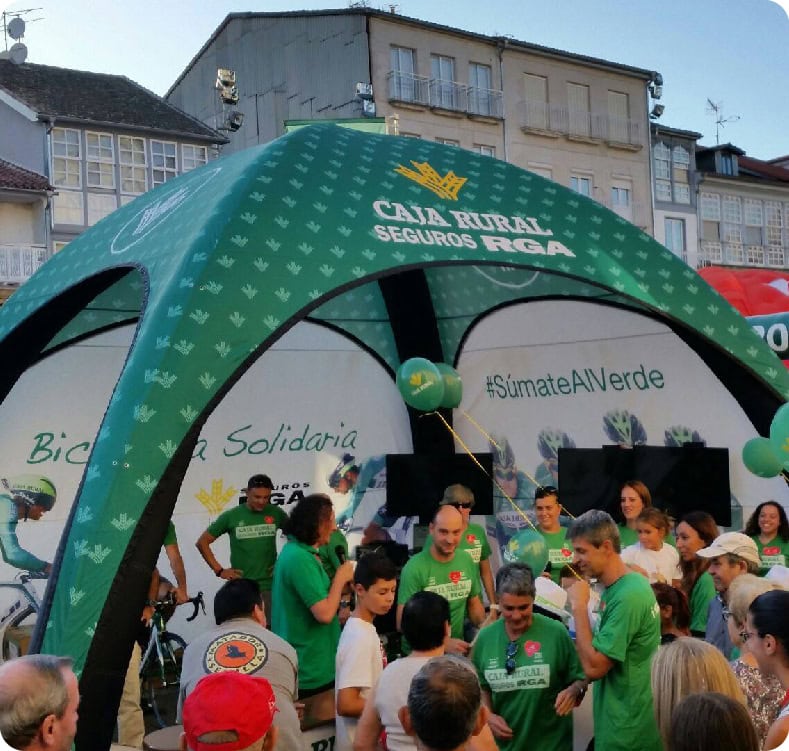
Charity-Ride Village Dome
A branded dome anchors a mass-participation cycling event, with matching teardrop flags marking the route - the layout a club or promoter repeats at every ride on the calendar.
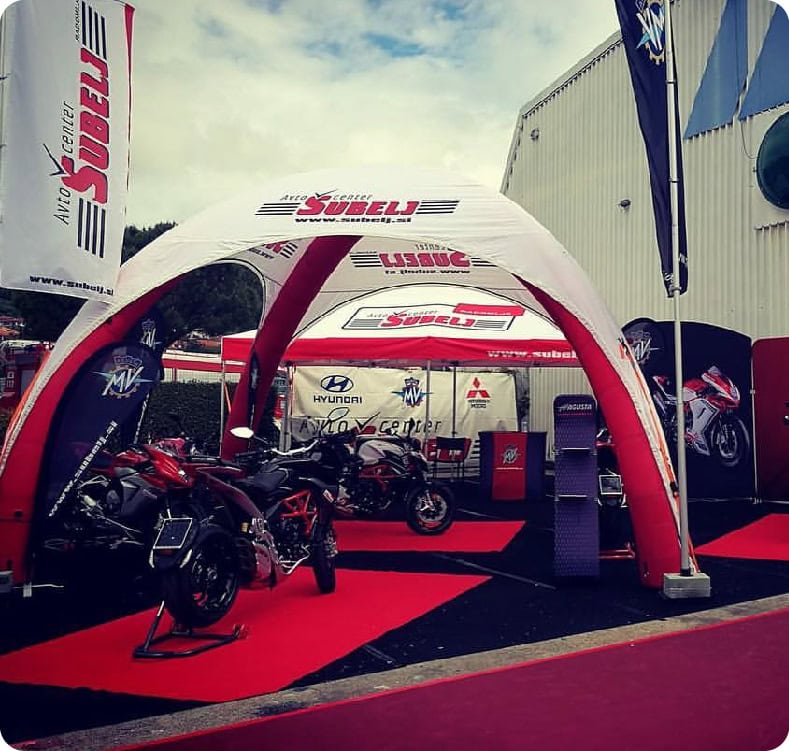
Paddock Shelter for a Dealer Event
An inflatable dome plus matching awnings covers a motorcycle dealer's outdoor display, with a flag line extending the branding across the forecourt.
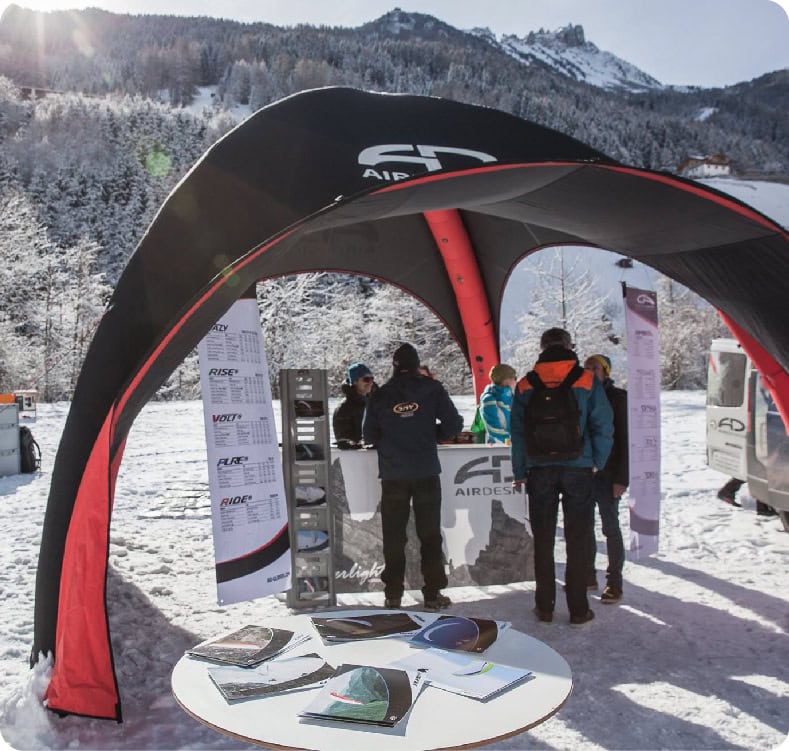
Base-Area Dome for a Ski Program
A printed dome works as a base-area shelter through a winter season, pitched on snow beside the slopes - a seasonal program that repeats from the same approved proof.
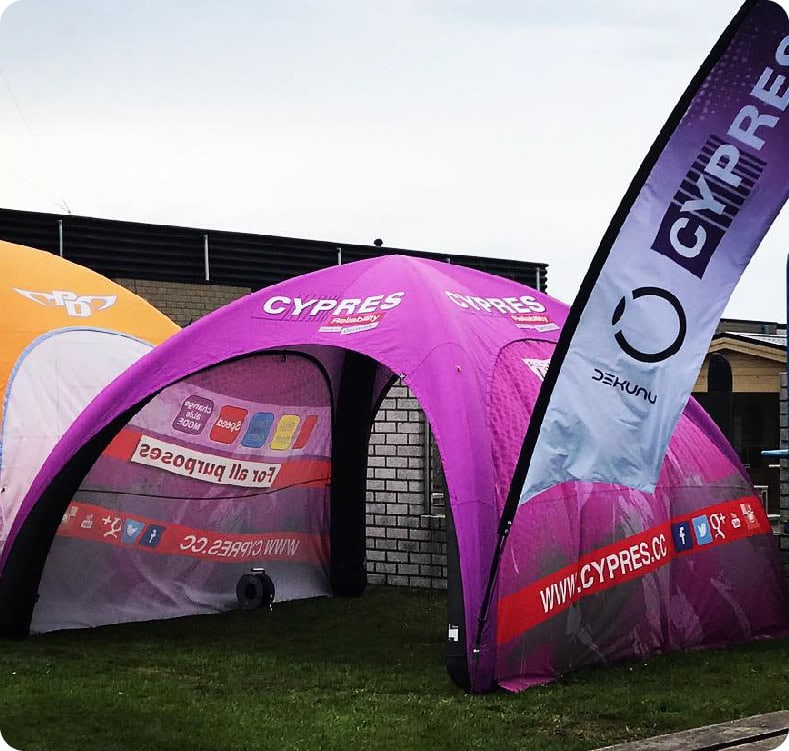
Landing-Zone Dome for a Skydiving Brand
A full-print dome serves as the landing-zone base for a skydiving equipment brand, with a teardrop flag for wayfinding - edge-to-edge print that reads from the air.

Tell Us Your Layout — Get the Quote in Writing
Ready to Plan the Event Layout?
Tell us the sport, the date and the footprint - we will map the arch, dome and flag layout against your course map and put the quote in writing.

