المستندات التصديرية الأساسية لشحنات الخيام القابلة للنفخ إلى الولايات المتحدة الأمريكية
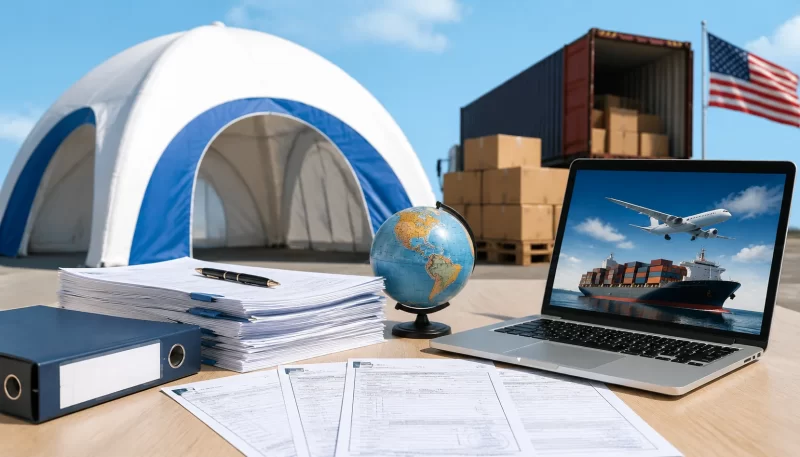
So you landed the order. The inflatable advertising tents are sewn, the blowers are tested, and your container is packed tight. It’s sitting at the loading port, ready to sail. Then your phone rings. It’s your freight forwarder, and their voice has that particular tension that means bad news.
“Shipment’s on hold at Customs. Missing documents.”
That call costs money. Demurrage fees at the terminal. Per-diem charges on the container. A pissed-off buyer who was counting on those tents for a trade show next week. I’ve seen it happen more times than I care to count.
This guide walks you through every key export documents for inflatable tent shipments to the USA, so you don’t get that call. Most guides out there are either painfully generic or come from companies trying to sell you their own tents. This is different. I’m not selling inflatables. I’m giving you the straight-up, neutral, step-by-step playbook based on years of watching shipments sail — and sink.
Let’s get into it.
Your At-a-Glance Document Checklist for US Customs
Before I dive deep into each document, here’s the quick-reference list. Bookmark this. Print it out. Tape it to your shipping station.
- Commercial Invoice — The legal bill of sale showing value, description, and HS code
- Packing List — Itemizes every box, weight, and dimension in the shipment
- Bill of Lading — The contract of carriage and title document (or Air Waybill for air freight)
- Importer Security Filing (ISF 10+2) — Pre-arrival security data filed with CBP
- Customs Bond — Financial guarantee to US Customs (Single Transaction or Continuous)
- Certificate of Origin — Proves where the goods were manufactured
- Flame Retardancy / Safety Certificates — Required for inflatable products used near people
- Proforma Invoice — Not a legal document, but essential for initiating payment and LCs
Now let’s break each one down. The devil, as they say, is in the details.
The Foundation: Commercial Invoice & Packing List
These two documents are the bread and butter of every international shipment. Without them, nothing moves. But here’s where most exporters screw up — they treat them like domestic invoices, and that’s a recipe for delays.
Commercial Invoice — Your Legal Bill of Sale
According to the U.S. Commercial Service (trade.gov), the commercial invoice is “a legal document between the exporter and the buyer that clearly states the goods being sold and the amount the customer is to pay.” It’s also “one of the main documents used by customs in determining customs duties.”
If you’re shipping inflatable advertising tents to the USA, here’s what U.S. Customs and Border Protection (CBP) expects to see on that invoice:
- Seller and buyer full legal names and addresses
- A precise description of the goods — Not just “tents.” Write “Inflatable advertising tents, made of PVC-coated polyester fabric, with integrated blower, complete with tethers and stakes.”
- Quantity in units (e.g., 50 tents)
- Unit price and total value in the currency of sale
- HS Code — Down to 10 digits for the US market (more on HS codes later)
- Country of origin — Where the tents were actually manufactured
- Terms of sale (Incoterms) — e.g., FOB Shenzhen, CIF Long Beach
- Payment terms — e.g., T/T, Letter of Credit
Honestly, I’ve seen shipments held because someone wrote “various inflatable items” in the description. Customs wants specifics. Vague descriptions trigger red flags. CBP regulation 19 CFR §141.86 specifies the required data fields, and if you miss one, your shipment could sit in a bonded warehouse for days.
Packing List — No, It’s Not Optional
Many exporters treat the packing list like an afterthought. Big mistake.
The packing list is “considerably more detailed and informative than a standard domestic packing list,” according to trade.gov. It itemizes every single package in the shipment. For inflatable tents, you need:
- Number of cartons or packages
- Net weight vs. gross weight per package
- Dimensions of each package (L x W x H)
- Contents of each package (e.g., “Carton 1: 2 inflatable tents, 2 blowers, stakes, repair kit”)
- Marks and numbers on the packaging
Here’s a real case I encountered: an exporter listed 50 tents on the commercial invoice but only specified 10 cartons on the packing list. Customs opened the container because the declared weights didn’t match. Turns out each carton had 5 tents. That inconsistency cost the exporter time and an exam fee.
What is packing list in export? It’s the document that tells customs exactly what’s in each box, how much each box weighs, and where each box is in the container. Without it, customs can’t verify the shipment matches the invoice. And they will hold it until they can.
The packing list and commercial invoice must match exactly. Any discrepancy — even 0.5 kg off on the total weight — can trigger a physical inspection.
The Shipment Contract: Bill of Lading (or Air Waybill)
This is your ticket. Your proof of ownership. Your contract with the carrier.
What Is a Bill of Lading?
The Bill of Lading (B/L) serves three functions:
- Receipt — Confirms the carrier received the goods in specified condition
- Contract of Carriage — States the terms under which goods will be transported
- Document of Title — Whoever holds the original B/L owns the cargo
For ocean freight, there are three main types:
- Master Bill of Lading (MBL) — Issued by the actual shipping line (e.g., MSC, Maersk)
- House Bill of Lading (HBL) — Issued by the freight forwarder or NVOCC
- Telex Release — Electronic release; no physical document changes hands
Here’s where it gets tricky. A Telex Release means the carrier releases cargo without requiring the original paper document. Some exporters use this before payment is confirmed — and I’ve heard about shipments being released before the exporter was paid. My advice: only use Telex Release if the buyer has paid in full. If you’re still waiting for payment, send the original B/L through the banking system.
Air Waybill (AWB)
For air freight, the Air Waybill is the equivalent document. But unlike the B/L, the AWB is not a document of title. It’s just a receipt and contract. This means air freight shipments are almost always released to the consignee without requiring an original document. Which is why getting paid before shipping by air is the industry standard.
Shipping line documentation requirements can vary between carriers, so always confirm with your forwarder which format they need. Some lines require an electronic submission via their portal; others still accept PDFs by email.
The US Customs Essentials: ISF 10+2 & Customs Bond
This is where inflatable tent exporters most commonly get tripped up. The ISF filing is not optional, yet I regularly meet exporters who have no idea it exists.
Importer Security Filing (ISF 10+2)
The ISF, often called “10+2,” is a data set that U.S. Customs and Border Protection requires to be filed before cargo is loaded onto a vessel destined for the United States. CBP uses it to assess security risk.
The “10” refers to the data elements required from the importer (or their agent):
- Seller name and address
- Buyer name and address
- Importer of record number
- Consignee number
- Manufacturer (or supplier) name and address
- Ship-to name and address
- Country of origin
- Commodity HS code (6-digit minimum)
- Container stuffing location
- Consolidator (if used)
The “2” refers to data from the carrier:
- Vessel stowage plan
- Container status messages
Deadline: The ISF must be filed no later than 24 hours before the cargo is loaded at the foreign port. But smart importers file it at least 7 days before the vessel’s departure from the last foreign port. Don’t cut it close.
If you fail to file, or file late, CBP can issue a penalty per violation. I’ve seen this happen to exporters who thought their freight forwarder would handle it — but the forwarder assumed the importer had filed. Always confirm who’s responsible.
Customs Bond
A customs bond is a financial guarantee to CBP that duties, taxes, and penalties will be paid. For any commercial shipment entering the US valued over $2,500, a bond is required.
There are two types:
- Single Transaction Bond (STB) — Covers one shipment. The premium is roughly a percentage of the shipment’s value, with a minimum fee.
- Continuous Bond (CB) — Covers all shipments for one year. Minimum coverage applies., but the actual amount depends on the importer’s total duty liability. Premiums are typically 1-2% of the bond amount.
For an exporter selling inflatable tents to a US buyer, the buyer (importer) is usually responsible for obtaining the bond. But if you’re selling Ex Works (EXW) or FOB and your buyer doesn’t have a customs broker yet, they might ask you to handle it. In that case, you’d work with a customs broker for inflatable tents who sets up the bond on the importer’s behalf.
Export entry document nuance: For non-commercial shipments or low-value goods, a formal entry might not be required. But for inflatable tents — which are commercial goods intended for advertising — you’re looking at a formal entry every time.
Product-Specific Documents: HS Code, Certificate of Origin & Safety Certificates
This is where most generic export guides fail. They tell you to get a “commercial invoice” and a “packing list” and call it a day. But inflatable advertising tents have specific requirements that can stop your shipment cold.
HS Code for Inflatable Tents
Getting the HS code wrong is one of the most common mistakes I see. And it matters because duties, restrictions, and even which government agencies review your shipment depend on it.
For inflatable advertising tents, there are two possible HS code classifications:
- 9503.00.0073 — “Toys representing animals or non-human creatures; inflatable toys.” If your tent is primarily used as a novelty or promotional item and is lightweight, this might apply. Duty rate: 0%.
- 6306.12.0000 — “Tarpaulins, awnings and sunblinds; sails; camping goods.” If the tent is larger, more structural, and used for actual shelter or event coverage, this is more likely. Duty rate: 0%.
Wait — both have 0% duty? Then why does it matter?
Because classification affects which government agencies may review your shipment. Under 9503, the Consumer Product Safety Commission (CPSC) may require testing. Under 6306, you might face different labeling requirements. Also, the 10-digit code affects trade data and future trade negotiations. CBP won’t reject a shipment just because you used the wrong 10-digit code if the 6-digit core is right, but consistent misclassification can trigger audits.
To find the exact code, use the USITC Tariff Database (HTS Search tool). A customs broker who understands export documents needed for inflatable tents is invaluable here.
ما هو رمز النظام المنسق (HS) للخيمة القابلة للنفخ؟ I recommend starting with 9503.00.0073 for smaller, novelty-style advertising tents, and 6306.12.0000 for larger structures. But always verify with a broker.
Certificate of Origin
A Certificate of Origin (CO) is a document that declares where your goods were manufactured. Even if the buyer doesn’t ask for one, you should get it.
Why? Because without a CO, your buyer can’t claim any preferential duty treatment under free trade agreements. For example, if your inflatable tents are manufactured in Mexico and being shipped to the USA, under USMCA (United States-Mexico-Canada Agreement), your buyer could claim duty-free entry — but only with a valid CO.
For goods manufactured in China and shipped to the USA, there’s no preferential duty treatment, but the CO still documents origin. Some buyers need it for their own records or for re-export to other countries.
The CO is typically issued by the local Chamber of Commerce. Some countries also allow electronic certificates. Always check with the Chamber in your exporting country — the process varies.
Flame Retardancy & Safety Certificates
Here’s the thing about inflatable advertising tents: they’re often used near electrical equipment (blowers, lights), in crowded public spaces (trade shows, festivals, sports events), and sometimes children interact with them. That combination attracts regulatory scrutiny.
The CPSC (Consumer Product Safety Commission) has flammability standards for products used in public spaces, including:
- 16 CFR Part 1610 — Flammability of clothing textiles
- 16 CFR Part 1630 — Surface flammability of carpets and rugs
For inflatable tents made of PVC-coated polyester or nylon, Part 1610 is usually the relevant standard. A third-party lab can test your material and issue a report.
Does CBP always require this? Not always. But if your tents are large enough to be considered “children’s products” or “products used in public spaces,” you want that certificate. Without it, a CPSC spot-check can result in a detention order. I’ve heard of entire containers being held for 30+ days waiting for lab test results.
If you’re exporting inflatable tents to the USA, get a flame test report from your supplier. Even if the current buyer doesn’t ask, the next one might. And it’s cheaper to test once up front than to explain to a customs officer why you don’t have it.
Proforma Invoice — The Opening Move
The proforma invoice isn’t a legal document for customs clearance, but it’s absolutely critical. The U.S. Commercial Service describes it as “an important document used as a negotiating tool between the seller and the buyer prior to an export shipment.”
Think of it as the prequel to the commercial invoice. You send it when you quote the buyer. It contains the same data — description, price, weight, terms — but it’s a proposal, not a bill.
For inflatable tent shipments, the proforma invoice serves several functions:
- Triggers the buyer’s payment or Letter of Credit application
- Provides the basis for the final commercial invoice
- Gives the forwarder and customs broker an early heads-up on what’s coming
Some buyers will ask you to include “proforma” in the description if they need it for their internal approval process. Always keep a copy with your transaction records.
Execution Timeline: From Quotation to Arrival
Documents in international trade follow a timeline. If you send them out of order, things go sideways. Here’s the flow for inflatable tents shipped from China (or anywhere) to the USA:
| When | Document | Who Prepares |
|---|---|---|
| At quotation | Proforma Invoice | Exporter |
| Before production | PO / Sales Contract | Both |
| After production | Packing List + Commercial Invoice | Exporter |
| Before vessel departure | ISF 10+2 | Importer or broker |
| After vessel sails | Bill of Lading | Carrier/Forwarder |
| Before arrival | Arrival Notice + Customs Entry | Broker |
| At clearance | Certificate of Origin + Safety Cert | Exporter |
The ISF deadline is the one that bites people. File it no later than 24 hours before cargo is loaded. In practice, you want to file as soon as you know the container number and vessel name. If you’re the exporter and your buyer expects you to handle this (some do), confirm in writing.
What Documents Are Required for Exporting to the USA?
This is the question I get asked most. And the answer depends on what you’re shipping.
What documents are required for exporting to USA? The core set is:
- Commercial Invoice (3-5 copies)
- Packing List (3 copies)
- Bill of Lading or Air Waybill
- Certificate of Origin (if applicable)
- ISF 10+2 (filed by the importer or broker)
- Customs Bond (obtained by the importer)
- Product-specific certificates (safety, testing)
For inflatable advertising tents, add the flame test certificate and any CPSC compliance documentation.
What are export documents? They’re the paperwork that proves you own the goods, describes what they are, confirms they were manufactured legally, and satisfies border security requirements. Every country has its own list. For the USA, CBP administers the rules.
ما هي وثائق إثبات التصدير؟ This refers to documents that prove goods actually left the exporting country — usually a Bill of Lading, Air Waybill, or export summary statement. Exporters need this for VAT/GST refunds, for proving compliance with export controls, and for certain tax purposes.
Common Mistakes Exporters Make
Let me save you some pain. Here are the mistakes I see most often:
1. Wrong HS code. Inflatable tents fall somewhere between toys and camping goods. Pick the wrong classification and you might face a different duty rate or agency review. Always check with a customs broker.
2. Missing flame test certificate. You don’t need it for every shipment, but when you need it and don’t have it, you’re stuck. Get the test done once and keep the report on file.
3. Inconsistent invoice and packing list. I’ve seen cases where the invoice says 50 tents at 20 kg each (1,000 kg total), but the packing list says 50 cartons at 22 kg each (1,100 kg total). Customs sees this and flags the entire shipment.
4. Late ISF filing. The 24-hour rule is a minimum. File earlier. Penalties up to $5,000 are real. CBP discretion isn’t something to bet your shipment on.
5. Confusing who handles the customs bond. If the buyer doesn’t have a bond and you assumed they did, the shipment arrives and no one can clear it. Demurrage fees accumulate at a range per day per container.
6. Not confirming the Bill of Lading instructions. Your buyer might need a Telex Release or an original B/L sent via courier. If you get this wrong, cargo gets released without payment, or it sits at the port.
7. Forgetting the Certificate of Origin. Maybe the buyer doesn’t need it today. But they might for their next transaction with you. Having it ready saves weeks of follow-up.
Choosing a Customs Broker for Inflatable Tents
You might be wondering: can I do all this myself? Technically, yes. But practically, no.
A customs broker licensed by CBP handles the actual clearance entry. For inflatable advertising tents, look for a broker who:
- Has experience with HS code 9503 or 6306
- Knows CPSC flammability requirements
- Can set up a Single Transaction Bond or Continuous Bond quickly
- Communicates clearly about ISF deadlines
I’ve worked with brokers who specialize in promotional products and outdoor gear. They know the quirks — when a flame test is needed, when a Certificate of Origin suffices, and when you need a formal entry versus an informal one.
If you’re new to this, ask your freight forwarder for broker recommendations, or search the CBP database of licensed brokers. A good broker pays for themselves in avoided delays and penalties.
أفكار ختامية
Export clearance documents aren’t a formality — they’re the difference between a smooth sale and a nightmare. For inflatable advertising tents heading to the USA, the checklist is clear:
- Commercial invoice with precise descriptions and correct HS code
- Packing list that matches the invoice perfectly
- Bill of Lading issued correctly (type matters)
- ISF 10+2 filed no later than 24 hours before loading
- Customs bond in place (STB or CB)
- Certificate of Origin for duty claims and buyer records
- Flame retardancy test report for safety compliance
This is the definitive list of key export documents for inflatable tent shipments to the USA. I’ve seen too many good products sitting in customs holds because someone skimped on paperwork. Don’t let that be you.
Which of these documents is your weakest link? Is it getting a flame-test report from your supplier? Filing the ISF on time? Or confirming the customs bond with your buyer? Fix that one link first. Start by downloading a checklist template and sending it to your freight forwarder today. The port won’t wait for you.
الأسئلة الشائعة
Q: Which documents are required for exporting?
١. ج: تشمل المستندات الأساسية الفاتورة التجارية، وقائمة التعبئة، وبوليصة الشحن البحري أو الجوي، وشهادة المنشأ، وأي شهادات خاصة بالمنتج. بالنسبة للشحنات إلى الولايات المتحدة الأمريكية، تحتاج أيضًا إلى تقديم إفادة ISF 10+2 وسند جمركي. تختلف القائمة الدقيقة حسب المنتج والوجهة. بالنسبة للخيام الإعلانية القابلة للنفخ، أضف شهادة اختبار مقاومة اللهب.
Q: What is the HS code for inflatable tent?
١. ج: Inflatable advertising tents are typically classified under HS code 9503.00.0073 (toys, games, and inflatable toys) or 6306.12.0000 (tarpaulins, awnings, and camping goods). The correct code depends on the tent’s primary use, size, and construction. Smaller promotional tents often fall under 9503; larger event tents under 6306. Confirm with a customs broker.
Q: What is proof of export documentation?
١. ج: وثائق إثبات التصدير تشير إلى السجلات التي تثبت أن البضائع غادرت فعليًا الدولة المُصدِّرة. وتشمل هذه الوثائق عادةً بوليصة الشحن البحري، أو بوليصة الشحن الجوي، أو بيان ملخص التصدير. تطلب الحكومات والسلطات الضريبية هذه الوثائق لاسترداد ضريبة القيمة المضافة/ضريبة السلع والخدمات، والمطالبة بحوافز التصدير، والتحقق من الامتثال. بالنسبة للخيام القابلة للنفخ التي يتم شحنها إلى الولايات المتحدة الأمريكية، تُعد بوليصة الشحن البحري أو بوليصة الشحن الجوي بمثابة إثبات.
Q: What are export documents?
١. ج: Export documents are the paperwork required to legally ship goods across international borders. They include commercial invoices, packing lists, bills of lading, certificates of origin, and any product-specific permits or test reports. Their purpose is to prove ownership, describe the goods, verify origin, satisfy customs security requirements, and enable the importer to clear the shipment. For inflatable tents to the USA, the key documents include the ISF 10+2 filing and flame retardancy certificates.
المراجع
1. Common Export Documents – U.S. Commercial Service (International Trade Administration)
2. Basic Importing and Exporting – U.S. Customs and Border Protection