إجابة سريعة
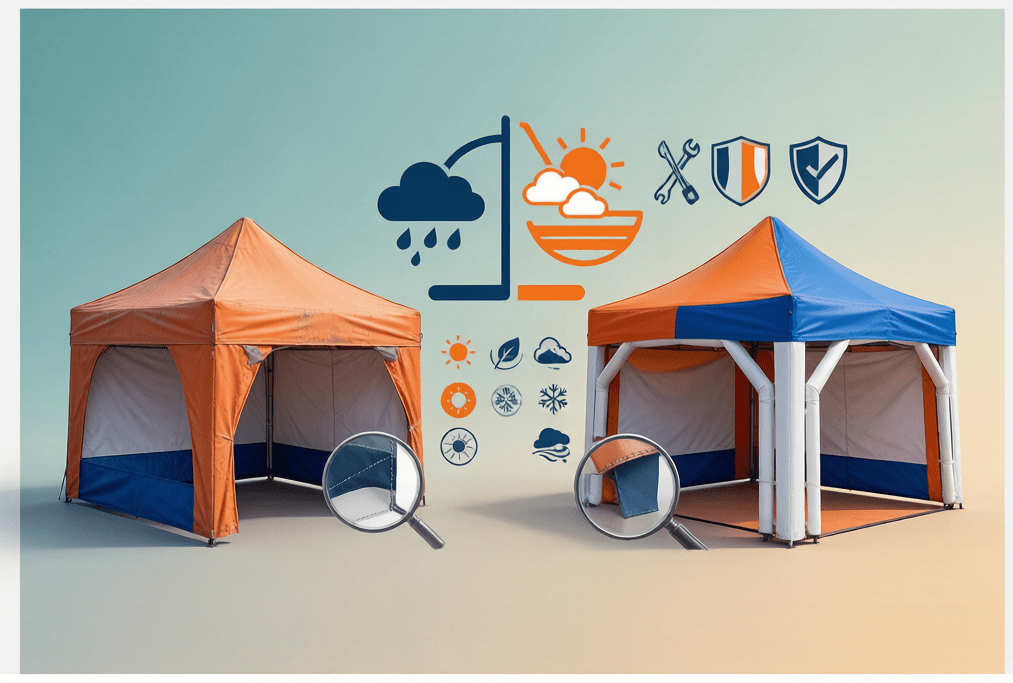
PVC wins on raw durability for inflatable advertising tents — it handles UV, abrasion, and repeated setup better than nylon, and holds printed graphics longer. Nylon wins on pack weight and upfront price. If you’re running more than a handful of events per year, PVC almost always costs less per year.
Anyone who’s ever bought an inflatable advertising tent knows the feeling. You pick one based on price, it shows up, you use it for a season, and then something goes wrong — the tube starts leaking, the print fades, or the whole thing just looks tired. I’ve watched this happen to event managers, rental companies, and marketing teams more times than I can count. And here’s the thing: most of those failures trace back to one decision made at the very beginning — material choice.
So let’s settle this properly. This is a Durability Showdown: PVC vs. Nylon Inflatable Advertising Tents — and I’m going to give you a verdict, not a wishy-washy “it depends” answer.
Why does this matter so much for advertising specifically? Because an advertising tent isn’t just shelter. It’s a billboard. When the print fades or the fabric sags, you’re not just losing a tent — you’re losing brand impressions at every event you attend. That changes the math on durability considerably.
PVC vs. Nylon: The Durability Verdict Up Front
Let me just say it plainly: PVC is the more durable material for inflatable advertising tents. It resists UV degradation better, holds printed graphics longer, and survives repeated inflation cycles with less wear. Nylon’s advantage is portability — it’s lighter and packs smaller.
Here’s the honest verdict in one breath: if your tent gets used more than a few times a year, or sits outdoors for weeks at a time, PVC is the smarter buy. If you’re hauling it in a sedan and setting up twice a year, nylon’s weight savings might matter more than its shorter lifespan.
That’s the whole showdown in a nutshell. The rest of this article is the evidence.
Head-to-Head Durability Comparison Table
I’ve pulled together the metrics that actually matter for commercial advertising use. These are the numbers buyers should be comparing — not marketing fluff.
| Metric | PVC (coated) | Nylon (400D–1000D) | ١. تي بي يو |
|---|---|---|---|
| Tensile strength | High — measured by oz/yd² fabric weight | Moderate — measured by denier (D) | عالي |
| مقاومة الأشعة فوق البنفسجية | Excellent, inherently stable | Moderate, degrades faster | Good |
| Abrasion resistance | Excellent | Good | Very good |
| Waterproofing | Inherent — no coating needed | Requires PU/silicone coating | Inherent |
| Mold risk in humid storage | منخفض | Higher — coating can trap moisture | منخفض |
| Typical lifespan (advertising use) | 10–15 years | 3–7 years | 8–12 years |
| Printability (dye-sub / direct print) | Excellent, sharp graphics | Good, but can bleed | Good |
| Fire retardancy options | NFPA 701 / CPAI-84 available | NFPA 701 / CPAI-84 available | Varies by supplier |
| الوزن | ثقيل | خفيف | متوسط |
| Upfront cost | أعلى | أقل | Highest |
A quick note on how to read this. PVC is sold by fabric weight in oz/yd², while nylon is sold by yarn thickness in denier. They’re measuring different things, which is exactly why so many buyers get confused.
Tensile Strength and Tear Resistance
This is where the denier confusion trips people up, so let me clear it up.
Nylon tent fabric is typically rated in denier — you’ll see “400D–1000D nylon” all over product listings. Denier measures the linear mass density of the yarn. Higher denier generally means a thicker, stronger yarn. But here’s the catch: denier tells you about the thread, not the finished fabric’s tear resistance. Two 600D nylons from different suppliers can perform very differently depending on weave and coating.
PVC, on the other hand, is usually spec’d by PVC weight — how many ounces per square yard the coated fabric weighs. A heavier PVC (think 18 oz/yd² and up) is a genuinely beefier material. It’s not just thicker yarn; it’s more material, period.
In my experience, a mid-weight PVC will outlast a heavy-denier nylon in tear resistance almost every time, because the PVC coating itself adds a layer of toughness that nylon’s thin coating doesn’t match. That said, if you’re comparing a cheap 200D nylon against a flimsy lightweight PVC, the nylon can win. Material grade matters more than the category name.
The takeaway: don’t compare denier to oz/yd² directly. Compare finished fabric performance, and ask your supplier for actual tear-strength data.
UV Resistance and Colorfastness for Advertising
For advertising tents, UV degradation is the silent killer. It doesn’t happen overnight — it happens over months of sun exposure, and it shows up first in your printed graphics.
PVC holds up far better under UV. It’s inherently more stable against sunlight, and the pigments used in PVC printing tend to resist fading longer. Nylon, by contrast, breaks down faster under sustained UV exposure — the fibers weaken and the coating can chalk or crack.
Why does this matter for printed graphics specifically? Because your logo, your brand colors, your messaging — all of it lives on the surface. When the fabric degrades, the print goes with it. A faded PVC tent still looks acceptable after a couple of seasons. A faded nylon tent starts looking cheap fast, and cheap-looking advertising is worse than no advertising.
If you want a real-world reference point, suppliers who run QUV accelerated weathering tests (which simulate sun exposure) typically report PVC holding color and structural integrity longer than nylon. Ask your manufacturer for QUV data if they have it — that’s the number that predicts colorfastness.
Waterproofing, Mold, and Weather Performance
Here’s a straightforward one: PVC is inherently waterproof. It doesn’t need a coating to keep water out — the material itself repels it. That’s a big deal for outdoor advertising where your tent might sit through a rainy weekend.
Nylon is not inherently waterproof. It needs a PU or silicone coating, and that coating can wear off over time. Once it does, water soaks in. If you’re comparing the waterproof performance of inflatable tents, this is the single biggest differentiator — PVC wins without much of a fight.
Then there’s mold. This is the part people forget until it’s too late. Nylon’s coating can trap moisture, especially if you pack the tent away damp. Store it in a humid warehouse for a few months and you may open it to find mildew — which stains the fabric and ruins the print. PVC dries faster and resists mold growth much better, which matters enormously if you’re storing tents between events in anything but a climate-controlled space.
My advice: whatever material you buy, never store it wet. But if you know your storage situation is imperfect, PVC is the safer bet.
Wind Load and Structural Behavior
Wind resistance comes down to how the material handles tension and flex.
PVC is stiffer and heavier, which means it holds its shape better in wind. It doesn’t flutter or flap as much, and that rigidity translates into more predictable structural behavior. For a sealed air chamber design — where the tube itself is the structure — PVC’s stiffness is an asset.
Nylon is more flexible. That flexibility can be good for packability, but in wind it means more movement, more stress on seams, and more wear over time. A nylon tent in a stiff breeze is working harder than a PVC tent of similar size.
There’s also the bladder question. Some inflatable tents use a TPU bladder inside an outer cover — the “wind-resistant outer cover” approach you’ll see in product comparisons. This design can combine the best of both: a tough outer shell with a reliable airtight inner tube. If you’re comparing wind-resistant outer cover options, look for a design where the outer fabric is PVC or heavy coated material and the bladder is TPU. That’s the combination that holds up.
And speaking of tubes — this is a real pain point I see constantly. Cheap inflatable tents deflate unless you get lucky with a 100% sealed tube. A poorly sealed tube will leak slowly, and you’ll be re-inflating it every few hours. When you’re evaluating any inflatable tent, ask specifically how the tubes are sealed. A well-made airtight chamber should hold pressure for days, not hours.
Lifespan and Real-World Field Data
Let’s talk numbers, because this is where the durability showdown actually gets decided.
In commercial advertising use, PVC inflatable tents are commonly claimed to last longer than nylon tents under the same conditions. That’s not a small gap. That’s a factor of two to three.
Where does this come from? Rental companies are the best source of real-world data here, because they use tents hard and track replacement cycles. The pattern I’ve seen and heard repeated across the rental industry is consistent: PVC tents get retired because the business outgrows them, not because they fail. Nylon tents get retired because the fabric wears out, the coating fails, or the print fades beyond use.
The inflatable tent lifespan difference shows up most clearly in high-frequency use. A rental fleet running many events a year may wear through nylon tents in a few seasons. The same fleet running PVC might get considerably more use out of the same inventory.
One caveat: this assumes comparable build quality. A cheap PVC tent from a no-name supplier won’t magically outlast a well-made nylon tent from a reputable manufacturer. Manufacturing quality — seam construction, valve quality, bladder sealing — matters as much as the base material.
Cost of Ownership: 5-Year and 10-Year TCO
Upfront price is a trap. Let me show you why.
Nylon tents cost less upfront. That’s real, and I won’t pretend otherwise. But cost per year is what actually matters, and the math flips fast.
Say a nylon advertising tent costs roughly half what a comparable PVC tent costs. Over a 5-year window, if the nylon tent needs replacing once (because it hit the end of its 3–7 year life), you’ve now spent more than the PVC tent cost — and you’ve dealt with the disruption of a replacement, reprinting graphics, and re-learning a new tent’s quirks.
Over 10 years, the gap gets ugly. A PVC tent that lasts the full decade is one purchase. A nylon tent might be two or three purchases in the same window, plus reprints each time.
So when does nylon’s lower price actually win? Honestly, in three scenarios:
- You need a tent for a single event or a short campaign, and longevity doesn’t matter.
- You’re weight-constrained — flying to events, shipping internationally, or working with strict vehicle limits.
- You’re testing a market and don’t want to commit capital before you know the tent will get used.
Outside those cases, PVC’s cost per year beats nylon’s upfront savings. That’s the insight most buyers miss.
Advertising-Specific Factors Competitors Miss
Most PVC-vs-nylon comparisons are written for campers. Advertising tents have different priorities, and here’s what the generic comparisons skip.
Printability. PVC takes dye-sublimation and direct printing beautifully — sharp edges, saturated colors, no bleed. Nylon prints well too, but the fabric’s texture and coating can affect ink adhesion. For brand-critical graphics, PVC gives you a cleaner result.
Fire retardancy. This is non-negotiable for commercial and public events. Both PVC and nylon can be treated to meet NFPA 701 and CPAI-84 standards, but you must confirm it in writing. Don’t assume. Ask for the certificate. Event venues and insurers will ask you for it.
Shipping weight and bulk. This is nylon’s genuine advantage, and it’s worth respecting. A nylon tent packs smaller and weighs less, which lowers shipping costs between events and makes solo setup more feasible. If your tent travels constantly, factor this in. But weigh it against the fact that you’ll be shipping a replacement nylon tent sooner.
Repairability. PVC patches cleanly and holds a repair well. Nylon repairs are doable but fussier, and a repaired nylon panel can behave differently under tension. For long-term ownership, PVC is easier to keep in service.
Recommendation Matrix: Which Should You Buy?
Here’s how I’d decide, scenario by scenario.
Choose PVC if:
- You run more than 5–10 events per year
- Your tent stays outdoors for extended periods
- Brand graphics need to stay sharp for years
- You want the lowest cost per year over a 5–10 year horizon
- Your storage isn’t climate-controlled
Choose nylon if:
- You’re doing one event or a short campaign
- Weight and pack size are your top constraints
- You’re testing whether inflatable tents work for your use case
- Upfront budget is genuinely the limiting factor
Consider TPU bladders inside a PVC or heavy outer cover if:
- You want the best of both — reliable airtight performance plus a tough, printable exterior
- You’re investing in a premium tent meant to last a decade
If I had to draw a single decision line: if the tent will be used more than a handful of times per year, buy PVC. Below that threshold, nylon is defensible.
This is the core of the Durability Showdown: PVC vs. Nylon Inflatable Advertising Tents — and the answer isn’t close for commercial use.
أفكار ختامية
Durability isn’t about the price on the invoice. It’s about cost per year, and by that measure PVC wins for any advertising tent that sees regular use. So here’s the real question: how many events will it take before a cheaper nylon tent has cost you more than a PVC one would have? For most operations, the answer is fewer than you’d think. Match your material to your event frequency and your climate, and you’ll avoid the mistake most buyers make.
الأسئلة الشائعة
Q: What are the differences between nylon and polyester tents?
١. ج: Nylon is stronger and more elastic but absorbs more moisture and degrades faster under UV. Polyester resists UV better and holds its shape longer, but it’s slightly heavier and less abrasion-resistant. For advertising tents, both are lighter than PVC but generally shorter-lived. If you’re weighing a Canvas & Nylon Tent against PVC for commercial use, PVC still wins on lifespan and printability.
Q: Are inflatable tents dependable?
١. ج: Yes — if the tubes are properly sealed. The single biggest reliability issue is deflation from poorly sealed air chambers. A well-made airtight inflatable tent should hold pressure for days. Ask your supplier directly how the tubes are sealed, and look for a 100% sealed tube design. Material also matters: PVC and TPU chambers hold up far better than thin nylon over repeated inflation cycles.
Q: Do clear tents get hot?
١. ج: They can. Transparent inflatable dome tents trap heat because the clear material lets sunlight in but restricts airflow. In direct summer sun, interior temperatures can climb noticeably. If you’re comparing transparent inflatable dome tents with opaque options, plan for ventilation or shade, and consider scheduling clear-tent events for cooler hours or seasons.
Q: What are the downsides of pop-up tents?
١. ج: Pop-up tents are fast to deploy but typically use lighter fabrics and simpler frames, which limits their wind resistance and lifespan. For advertising use, they often can’t match the print quality or durability of a proper inflatable tent. If you’ve read a Pop-up Tent Durability Test Results and Recommendations report, you’ll see the same theme: convenience comes at a durability cost.
Q: How do I compare inflatable tents against traditional frame tents?
١. ج: It depends on your use case. An Inflatable Tent Vs Traditional Frame Tent for Rapid Police deployment, for example, favors inflatables for speed and portability. For long-term installations, frame tents can be more stable. It’s really a question of setup speed, storage, and how often you move it. For Exhibition Tent vs Inflatable Event Tent decisions, inflatables usually win on branding surface area and setup time.
Q: What’s the difference between inflatable tent fabric and Oxford cloth?
١. ج: Oxford cloth is a weave — a basket-weave fabric often made from nylon or polyester, sometimes coated for water resistance. It’s lighter and cheaper than PVC-coated fabric. The Difference Between Inflatable Tent Fabric Oxford Cloth and PVC comes down to coating and weight: Oxford cloth is typically a thinner, lighter option, while PVC-coated fabric is heavier, more waterproof, and more durable for commercial advertising.
Q: How do I compare waterproof performance across inflatable tents?
١. ج: Look at whether the material is inherently waterproof or relies on a coating. PVC is inherently waterproof; nylon needs a PU or silicone coating that can wear off. When doing a comparison of waterproof performance of inflatable tents, check the coating type, the hydrostatic head rating if provided, and whether seams are sealed. Also ask about mold resistance in storage.
Q: How do I compare popular inflatable tent models fairly?
١. ج: Start with the material spec, not the marketing photos. When doing a comparison of popular inflatable tent models in the advertising space, compare fabric weight (oz/yd² for PVC, denier for nylon), UV resistance data, fire ratings (NFPA 701 / CPAI-84), and print method. Then compare cost per year, not upfront price. That’s the only comparison that reflects real ownership cost.
المراجع
1. The Difference Between Inflatable Tent Fabric Oxford Cloth – gaiatarps.com
2. Durability Test of Inflatable Tents with Extreme Temperature – blog.yolloy.net