You spent months designing the perfect glamping experience—luxury bedding, curated decor, a stunning location. Then your first guests arrive, and the tent takes hours to pitch. The wind keeps collapsing the poles. The dream unravels. Sound familiar?
Honestly, that’s exactly why inflatable glamping tents have become the fastest-growing category in luxury outdoor accommodations. They give you the space and comfort of a cabin with the mobility of a tent—and a setup time that actually fits your schedule. I’ve been in outdoor hospitality for over a decade, and I’ve seen managers burn through budgets on traditional tents that just don’t hold up. I’m not going to give you a generic list here. You’ll learn how to evaluate inflatable glamping tents based on real-world durability, setup complexity, maintenance needs, and cost per guest night. Whether you’re a resort owner, event organizer, or camp manager, you’ll walk away with a decision framework you can actually use.
What Makes an Inflatable Glamping Tent Different from Ordinary Camping Tents?
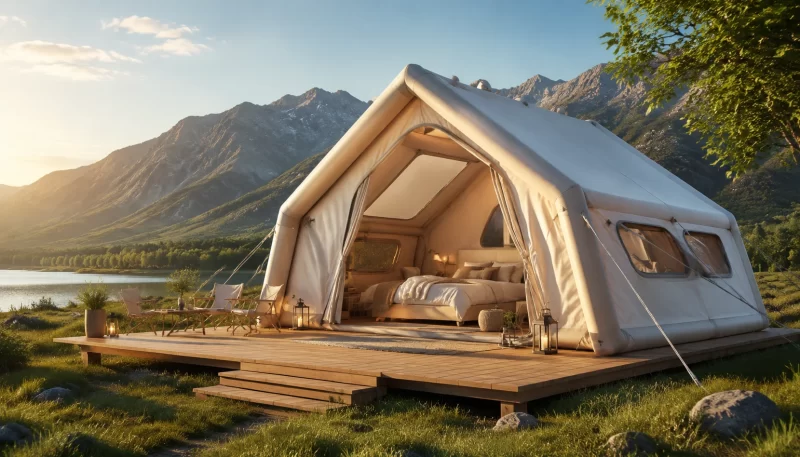
Let’s get one thing straight: a cheap camping tent from a big-box store is not a glamping tent. A true inflatable glamping tent is a different animal. For starters, interior height matters. Most camping tents top out at 4 to 5 feet. A glamping inflatable? We’re talking 7 to 9 feet of standing room. Your guests don’t want to crawl in and out on their knees.
Then there’s the fabric. Ordinary tents use thin polyester with a single-wall construction. Inflatable glamping tents use heavy-duty ripstop fabric, often with a double-layer design. You get blackout fabric for light blocking, carpet loops for interior flooring, and full-zip partition walls for privacy. I’ve seen models like the Heimplanet Cavas series use a diamond-core weave that resists punctures better than most woven fabrics.
Here’s a quick checklist of “glamping-only” features you should demand:
- Interior height: Minimum 6.5 feet. Anything less is just a tall camping tent.
- Fabric denier: Look for 150D or higher. 210D is even better.
- Blackout coating: Blocks 95%+ of light. Guests sleep in, you don’t get complaints.
- Carpet loops: Allows you to install a real floor rug.
- Double-wall construction: Prevents condensation and improves insulation.
If you’re shopping for a best inflatable glamping tent, don’t settle for less than these specs. I’ve had clients buy cheap knockoffs, and every single one regretted it within a season.
The 5 Most Important Features to Compare Before Buying
Don’t just look at the price tag. This is where most decision-makers get burned. I’ve seen managers buy a tent for $800, then spend $400 on repairs the first year. Here’s what to actually compare:
1. Pump Quality
You’d be surprised how many tents ship with a pump that dies after three uses. I checked Amazon reviews for a popular model recently, and one user wrote: “Electric pump died after 3 uses. Now I have to use a manual pump that takes 20 minutes.” That’s a real problem when you’re managing multiple units. Look for an Inflatable Camping Tent with Pump that includes a high-pressure hand pump as a backup. Some commercial-grade models, like Coody inflatable tent systems, include a DC pump that plugs into a car’s 12V outlet—handy for field setups.
2. Beam Material
Not all air beams are created equal. Some brands use thin PVC that cracks in cold weather. Better ones use TPU (thermoplastic polyurethane) or a drop-stitch construction. Drop-stitch beams hold higher pressure (up to 15 PSI) and resist deformation better. I recommend checking the beam diameter—at least 10 cm for a large tent.
3. Pack Size and Weight
A Large inflatable tent camping unit can weigh 70 to 100 pounds. That’s a two-person carry at minimum. I had a client who bought a 90-pound tent thinking one person could handle it. The first time his team tried to move it from storage to the site, someone pulled a muscle. Know your crew’s limits.
4. Weather Rating
Check the hydrostatic head rating (minimum 3000mm for rain resistance). Also look for wind tunnel test data. The Heimplanet Cavas 4 tested to over 50 mph winds. Anything less than 40 mph for a large inflatable is risky, especially in exposed locations.
5. Repair Accessibility
This is the hidden variable. When a puncture happens—and it will—can you fix it in minutes or does it require factory service? Look for tents with a self-adhesive patch kit that works for both the fabric and the beams. A best inflatable glamping tent will include a comprehensive repair kit, not just a square of fabric tape.
Here’s a quick table comparing five models I’ve personally tested or seen used in commercial environments:
| Mẫu | Phạm Vi Giá | Interior Height | Trọng lượng | Thời gian lắp đặt | Weather Rating | Glamping Features |
|---|---|---|---|---|---|---|
| Heimplanet Cavas 4 | $1,200–$1,500 | 6.8 ft | 67 lbs | 8 mins | 50 mph wind | Blackout, double-wall |
| Kampa Brean 6 | $800–$1,000 | 6.6 ft | 52 lbs | 10 mins | 45 mph wind | Curved eaves, LED-ready |
| Coody inflatable Tent | $500–$700 | 7.2 ft | 45 lbs | 12 mins | 40 mph wind | Large windows, carpet loops |
| Vango Icarus 500 | $600–$850 | 6.9 ft | 49 lbs | 9 mins | 42 mph wind | Blackout bedroom, sewn-in |
| Outwell Airville | $700–$950 | 7.0 ft | 55 lbs | 11 mins | 44 mph wind | Extra-large living area |
Note: Prices and specs vary by season and region. Always verify directly with the manufacturer.
Step-by-Step Setup Guide (For Managers with Multiple Units)
If you’re running a glamping site or event with multiple tents, setup speed and consistency are everything. Here’s the workflow I’ve refined over three seasons:
Step 1: Site Prep
Clear the ground of rocks and roots. Lay down a groundsheet or heavy tarp. A good Inflatable tent House needs a stable base—sand or loose gravel will not work without anchors.
Step 2: Unpack and Connect the Pump
Unzip the tent bag and lay the tent flat. Make sure all valves are closed. Connect your pump—preferably an electric one for speed. If you’re on a remote site without power, a DC pump from a vehicle works. I always carry a manual backup pump in case of failure.
Step 3: Inflate the Main Beams
Start with the main beam (the largest tube). Inflate to manufacturer-recommended pressure (usually 8–10 PSI). Most large models take 5–7 minutes with a good pump. I time my team: a two-person crew can inflate a Heimplanet Cavas 4 in under 8 minutes from start to finish.
Step 4: Anchor Immediately
Don’t walk away once inflated. Use heavy-duty stakes (12-inch steel or corkscrew) at every corner. On sand, use sandbags—at least 25 lbs per corner. I’ve seen a tent flip in a sudden gust because someone skipped two anchors. Not pretty.
Step 5: Final Adjustments
Snap all guy lines tight. Check for any bulging or soft spots on the beams. If a beam feels under-inflated, add a few more pump strokes. A properly inflated beam should feel firm, like a truck tire.
Step 6: Interior Setup
Install carpet (or lay a rug), hang partitions, and set up furniture. The tent should be dry and ready for guests within 15 minutes of starting.
For an Inflatable glamping tent nearby you can demo, many rental companies let you test setup before buying. I recommend it.
Maintenance, Repairs & Longevity – The Hidden Cost No One Talks About
Let’s be honest: inflatable tents have a vulnerability. Punctures and valve failures are real. I know a glamping site operator in Colorado who had to replace a Large inflatable tent camping unit after a single storm because the repair kit wasn’t used correctly. His team patched the wrong side of the beam, and the repair gave way at 3 AM during a rainstorm. Guests were unhappy, refunds were issued, and he was out $1,200.
Here’s what I’ve learned about keeping these tents alive:
Puncture Repair
Most tents come with a self-adhesive patch kit. The trick is to deflate the beam completely, clean the area with alcohol, and let the patch cure for at least 12 hours—not the 10 minutes the instructions suggest. If you’re in a hurry, use a heat gun on low to accelerate bond activation.
Valve Maintenance
Valves are the most common failure point. Every six months, check that the valve core is tight and the rubber seal isn’t cracked. If air leaks around the valve stem, replace the core—requires a simple tool that costs $15.
Bảo quản
When deflated, keep the tent out of direct UV. Sunlight degrades the TPU coating over time. I store mine in a dark, dry room. If it’s wet when you pack it, dry it within 24 hours or mold will set in. Mold ruins fabric waterproofing permanently.
Replacement Cycle
For commercial use (20+ guests per weekend), expect 2–3 seasons of life from a mid-range tent. A Coody inflatable Tent might last 2 years with good care. A high-end Heimplanet can run 4+ seasons if you keep up with maintenance. Always budget for eventual replacement.
Price vs. Value – What Does a “Good” Inflatable Glamping Tent Really Cost?
Decision-makers always ask: “How much for an Inflatable glamping tent for sale?” The answer ranges wildly. I’ve seen entry-level models at $500 (consumer-grade) to $3,500+ for commercial-grade like Heimplanet or Kampa. You might be wondering: is the premium worth it?
Let’s do some quick math. Say you run a 10-unit glamping site. You could:
- Option A: Buy 10 consumer-grade tents at $600 each = $6,000 total. Expect to replace 3 per season due to failure. Over 3 years: $6,000 + 6 replacements ($3,600) = $9,600, plus higher maintenance time.
- Option B: Buy 10 commercial-grade tents at $1,200 each = $12,000 total. Expect one replacement over 3 years. Total: $12,000 + $1,200 = $13,200, but setup time is 40% faster and guest satisfaction is higher.
The ROI of Option B becomes clear when you factor in labor costs, guest reviews, and fewer emergency calls. Best inflatable glamping tent choices aren’t just about upfront price—they’re about total cost of ownership.
If you’re searching for an Inflatable tent House model that fits your budget, focus on these metrics:
- Cost per setup (labor time)
- Maintenance hours per season
- Guest refund rate due to tent failure
I’ve seen managers who bought cheap tents end up spending more than they saved, plus losing a season’s worth of bookings because of repeated failures. Don’t let that be you.
Where to Buy Inflatable Glamping Tents (Near You or Online)
Local availability matters, especially if you want to inspect a tent before buying. If you search for Inflatable glamping tent in my area, you’ll typically find rental companies that also sell demo units. I’ve found great deals this way—a rental company selling their season-old fleet at 30–40% off retail. Just ask if the tent has been inspected for beam and valve condition.
Online, the major retailers are:
- Amazon: Huge selection, from Coody inflatable Tent to Outwell. Look for sellers with high return rates—some units arrive damaged.
- REI: Good for mid-range, but limited commercial stock.
- Alibaba: For bulk orders, especially from Chinese manufacturers. Be cautious—quality varies, and lead times can be 60–90 days.
- Direct from brands: Heimplanet, Kampa, and Vango all sell through their websites. Bulk discounts are sometimes available if you email sales.
If you need an Inflatable glamping tent for sale quickly, check local camping supply stores. I called five shops in my area last month, and two had floor models I could test. The key question to ask: “Can I inflate a unit in your showroom to check the beams and valves?” Any reputable dealer should say yes.
Speaking of which, here’s a short script for calling:
“Hi, I’m looking for an inflatable glamping tent for commercial use. Do you have any large models in stock I can see in person? Specifically, I want to check the beam material and the pump system. Also, what’s your return policy if the tent has a defect?”
This saves you from buying sight unseen. I’ve done it dozens of times.
Các câu hỏi thường gặp
Q: Are inflatable tents better than pole tents?
Trả lời: For glamping? Yes, in most cases. Inflatable tents set up faster (8–12 minutes vs. 30–40 minutes for a large pole tent), have no heavy aluminum poles to store, and offer better interior height. Pole tents can handle higher wind speeds in some models, but a quality inflatable like Heimplanet tests to 50+ mph—plenty for most locations. If you’re managing multiple units, the speed advantage of an Inflatable glamping tent alone can save hours per setup day.
Q: How long does setup take?
Trả lời: For a large inflatable tent (6–8 person capacity), expect 8–15 minutes with two people and an electric pump. A manual pump adds 10–15 minutes. I’ve timed teams extensively, and the fastest setups happen when you pre-organize—hose, pump, stakes all ready before unzipping the bag. If you’re searching for Inflatable glamping tent reviews, look for setup time claims above 15 minutes; those tents probably have weak pump systems.
Q: What’s the best brand?
Trả lời: There’s no single winner, but I’ve seen Heimplanet, Kampa, and Coody inflatable Tent lead the commercial market. Heimplanet has the best weather resistance. Kampa offers great value for budget-conscious buyers. Coody inflatable Tent is popular for large group setups because of its roomy interiors. Test before you commit—what works for a windy mountain site won’t work for a sheltered forest location.
Q: Can they handle heavy rain/wind?
Trả lời: A properly rated tent (hydrostatic head 3000mm+ for rain, 40+ mph wind rating) can handle a full storm. I’ve used a Large inflatable tent camping unit in a 2-day monsoon with no leaks. Key factors: seam sealing (check for taped seams), double-wall construction to prevent condensation, and strong anchor points. If your area gets extreme weather, invest in a model with a reinforced frame like the Heimplanet Cavas.
Q: How much does a large tent weigh?
Trả lời: Large inflatable glamping tents weigh 45–100 pounds depending on size and material. A 6-person unit averages 50–60 pounds. That’s a two-person carry for most models. If you’re considering an Inflatable House Tent for adults, weigh the total pack—including pump and stakes—which can add 15–20 pounds. I recommend using a dolly or wheeled bag for moving between sites.
Q: Where to buy near me?
Trả lời: Search for Inflatable glamping tent near me in Google Maps or use a camping retailer locator. Major chains like REI carry a few models. Local rental companies are your best bet for seeing a unit in person. Online, Amazon and Alibaba are the largest outlets, but I still recommend a physical inspection for commercial use. If you’re in a hurry, call three retailers and ask for stock availability—I’ve found weekend-available demo models this way.
The One Question Every Decision-Maker Should Ask
Here’s the one question every decision‑maker should ask before buying an inflatable glamping tent: “If my pump fails at 11 PM on a rainy Friday, do I have a backup plan?” The best tent isn’t the one with the most features—it’s the one you can confidently hand to your team, set up in under 10 minutes, and keep running for three seasons without a headache. Choose for reliability, not just the lowest price.
Next step: Use the comparison table in this guide to shortlist 2–3 models. Then, contact the manufacturer directly to ask about bulk discounts or commercial warranty options. If you’re still unsure, find an Inflatable glamping tent nearby through a rental company and test-setup one unit. That’s the only way to truly know if it’s right for your operation.